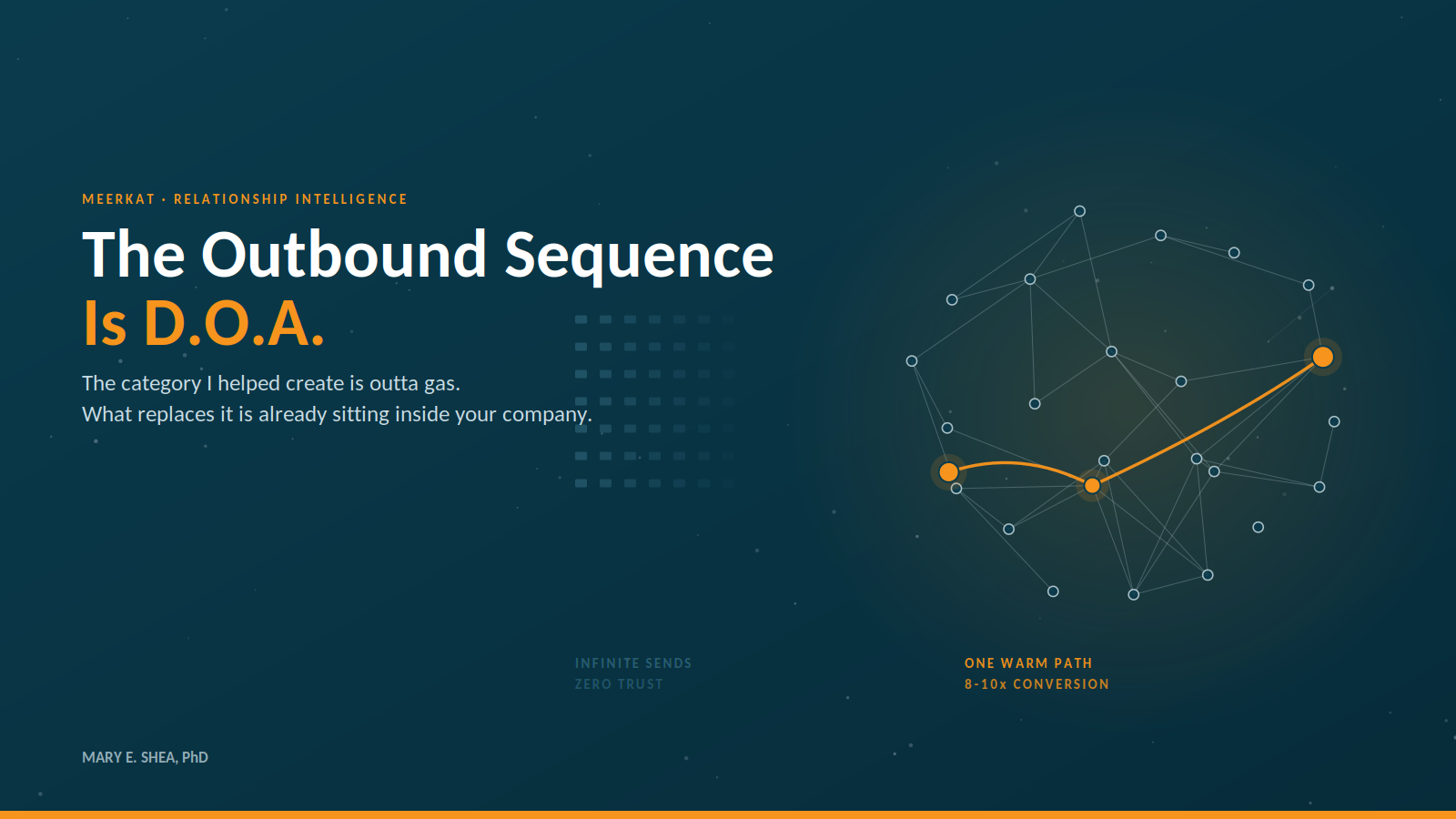
The category I helped create is outta gas. What replaces it is already sitting inside your company.
By Mary E. Shea, PhD
Drafted with Claude (Anthropic). The research, interviews, and arguments are mine.
Is it just me, or are you at your wits' end too? Email, LinkedIn DMs, text. Each one opens with a flattering reference to my company's value proposition, a sycophantic take on my latest LinkedIn post, or a nod to our branding, all of it a runway to pitch-slap me into buying cybersecurity, the next transformational AI tool, or outbound demand gen. None of it came from a person. All of it was engineered to feel like it did.
I have real respect for the selling profession. I built my career in it. For years I purposely tried to answer every piece of outbound that came my way, because I knew someone on the other end had a number to hit, and I remembered exactly what that felt like.
I stopped. Not because I have stopped caring, but because the sheer volume is mind-numbing. Something has to give.
I helped create this category. As a principal analyst at Forrester, I spent years researching sales engagement and authored the inaugural Forrester Wave, which defined and named the market. I didn't do it alone. The providers building the technology and the revenue teams using it in the field shaped that definition as much as any research I published. We built the category together.
In 2021, I went to work for one of those unicorn providers. As Outreach's Chief Evangelist, my job was to convince revenue leaders that sales engagement platforms, namely ours, would transform B2B selling. I stood on stages all over the world and educated and enlisted executives. I was very convincing. I was also, eventually, wrong.
Not wrong about the technology. Wrong about how long the window would stay open.
The numbers stopped working
Cold email reply rates hit 3.43% in 2026. They were 8.5% in 2019 and roughly 5% a year ago, according to Instantly's analysis of billions of cold email interactions. The Bridge Group benchmarks 300-plus SDR organizations annually and found that outbound sequence reply rates have fallen by 35 to 45% since 2022. Studies of unmanaged volume sending now clock reply rates at 0.45%.
That last number deserves a second read. One reply per 222 sends.
The cause isn't mysterious. AI SDR platforms pushed an estimated four to seven times more cold email into B2B inboxes between 2024 and 2025 than in 2022. Google and Microsoft answered with the harshest deliverability crackdowns the channels have ever seen. Buyers answered by muting, blocking, and ignoring.
And email is only one lane. The same engines now run LinkedIn DMs, SMS, WhatsApp, and voice, so a single prospect absorbs the same manufactured familiarity from four directions at once. Agentic AI made contact infinite, and infinite contact is worthless. When everyone can reach everyone everywhere, the send itself has no value.
One number refused to budge: a warm introduction still converts at 15-25%. Eight to ten times better than cold. The scarce asset was never the email. It was always the trust behind it.
Hyper-personalization made it worse, not better
Here's the part the industry still gets backwards. The answer to declining reply rates is always more personalization, generated faster and at higher volume. That doesn't fix the problem. It magnifies it.
Dr. Stefanie Boyer, professor of marketing at Bryant University, puts it plainly in an interview for my current research:
“There's so much personalized outreach that is God-awful. It's disguised as trying to be personal, but it's not personal at all.”
Recipients can tell. That's the whole problem. A message engineered to feel intimate, sent by a machine that's never met you, doesn't just fail to land. It costs the sender credibility they haven't earned yet. Scaled personalization isn't a diminishing return. It's a credibility overdraft.
Jessica Baker, Chief Innovation Officer at AchieveUnite, knows what this looks like from the receiving end. She posted a job req. Twenty-five AI-generated resumes landed in five minutes. She pulled the listing and hired through her network instead. Her conclusion:
“It has to be from your network, and that's relationship capital right there.”
When a channel floods, the people you already know become the only reliable signal left in it.
What replaces the sequence
AI compresses the cost of information, expertise, and execution. As those advantages commoditize, relationships become the scarcest source of competitive advantage.
I call this asset Relationship Capital: the trust, shared context, institutional memory, and network strength embedded in an organization's people. Like financial capital, it compounds when you invest, appreciates when you maintain it, and depreciates when you ignore it. Unlike financial capital, almost nobody measures it, because almost nobody can see it.
This idea isn't new. L. J. Hanifan coined the term “social capital” in 1916. Granovetter proved in 1973 that weak ties, not close friends, carry opportunity. Burt showed that the brokers who bridge disconnected clusters capture the value. What's new is the urgency. For a century, this was sociology. In an agentic AI world, it's a balance sheet item.
Your company already owns more of it than you think. Your people walked in carrying networks built across entire careers: former colleagues, classmates, board seats, neighbors. None of it lives in your CRM, because most of it happened before they ever joined you.
I mapped it, and the scale surprised me
I mapped the alumni network of my own former employer, Forrester Research. It returned 6,793 alumni across 71 countries, with 110,072 people one introduction away and 2.32 million within two. One in three of those alumni now holds a title that decides something: founder, chief officer, head, director.
That network always existed. Nobody could search it, so it lived wherever someone happened to remember it.
Then I ran the same exercise on one company's current workforce. Roughly 1,900 employees already held working relationships with more than 11,700 buyers across the six roles that company sells to. Six hundred and ten of those buyers sat one introduction away.
None of it sits in a system. No seller can see it. No leader can act on it.
That's the pattern I now see everywhere. The pipeline most companies chase with sequences already exists inside their own walls; it's just invisible and unactionable.
The early data from my current research says the same thing. Among respondents so far, a majority say their organization's key external relationships are not in any shared system at all. Not in a CRM, not in a directory, nowhere anyone else can find them. These are directional early reads from a sample still in the field, and I'll publish the full numbers when fielding closes. But the direction is unambiguous: the asset is real, and almost nobody has instrumented it.
The best objection to all of this
Helen Fanucci, author of Love Your Team and a former Microsoft sales leader, published the sharpest challenge to this argument in July. She agrees cold emails are finished. Then she asks the question that matters:
“How many sellers have a strong enough network to consistently create introductions into their target accounts? When you ask for an introduction, you are asking someone to use their reputation, positional power, and relationship capital on your behalf.”
She's right, and the point deserves a real answer rather than a slogan. An introduction is an earned transfer of trust, not a transaction. Most individual sellers haven't earned it at the volume their quota demands, and telling reps to network harder isn't a pipeline strategy. Fanucci's answer is to make the phone easier to pick up: better tooling, calling blitzes, coaching, environments where the hard behavior becomes the easy one.
Here's where I part company, and it isn't with her diagnosis. It's with the unit of measurement.
The question isn't whether the seller has the relationship. It's whether the company does. That 1,900-person workforce holds 11,700 buyer relationships. No individual seller earned all of them, and none of them needed to. The trust already sits somewhere in the building: with a colleague two floors up, with a board member, with someone who left the company three years ago and still takes the call.
Sellers ask for introductions they haven't earned because they can only see their own contacts. Give a seller the map of what the whole organization already knows, and the ask changes completely. Now you're routing the request to the person who holds the relationship, and they're spending their credibility on a warm path that exists rather than manufacturing one that doesn't.
Fanucci's right that trust doesn't scale by asking harder. It scales when you make the company's relationships visible rather than leaving them stranded in individual memories.
The uncomfortable part
Relationship capital clusters. So far, half the respondents in the study say their organization's relationship capital is concentrated among a few well-connected people rather than spread across the team. It gathers in a handful of brokers, and when one of them leaves, it leaves with them.
John Burrows, Senior Lecturer in Leadership at the University of Chicago's Harris School and co-author of Social Capital at Work (Simon & Schuster, November 2026), watched this happen at scale. After Oracle acquired Siebel, the restructuring ran without any map of who held the organization together.
“Oracle came in and slashed and burned and lost a lot of good people. Where did nearly all those good people land? Salesforce.”
Most executives can't name their own brokers. That's not a talent problem. It's an instrumentation problem, and it's fixable.
What comes next
I'm not saying automation disappears. For commodity sales, the future is agent-to-agent, and agents will continue to absorb the early funnel across the board. But strategic sales still close through humans who trust each other, and that share of the work is about to matter far more, not less.
So, retire the eight-step drip. The future of selling is more human, with serious machinery behind it: technology that finds the real paths between people, and sellers who walk through them.
The sequence has had a good run. I should know. I helped create the category, then I helped executives bet on it. It mattered. It changed how an industry sold.
But the sequence scaled activity, not trust. What comes next must do both.
A note on method
I wrote this with Claude as a drafting partner. The thesis, the research, the interviews, and every argument here are mine. Given what this piece says about machine-generated content, you deserve to know how it was made. That's the distinction worth holding onto: a machine can help you write faster, but it cannot manufacture the trust, the relationships, or the original research behind the words.
Add your voice to the research.
The State of Relationship Capital 2026 is a mixed-methods benchmark study examining how executives build, lose, and measure relationship capital in an agentic AI world. The survey runs through early September and takes about eight minutes. Responses are anonymous.
Take the survey: https://trymeerkat.ai/relationship-capital-2026
Mary E. Shea, PhD, is Co-Founder and Chief Growth Officer at Meerkat and lead researcher of The State of Relationship Capital 2026. She previously served as a principal analyst at Forrester, Chief Evangelist at Outreach, and co-CEO of Mediafly.